
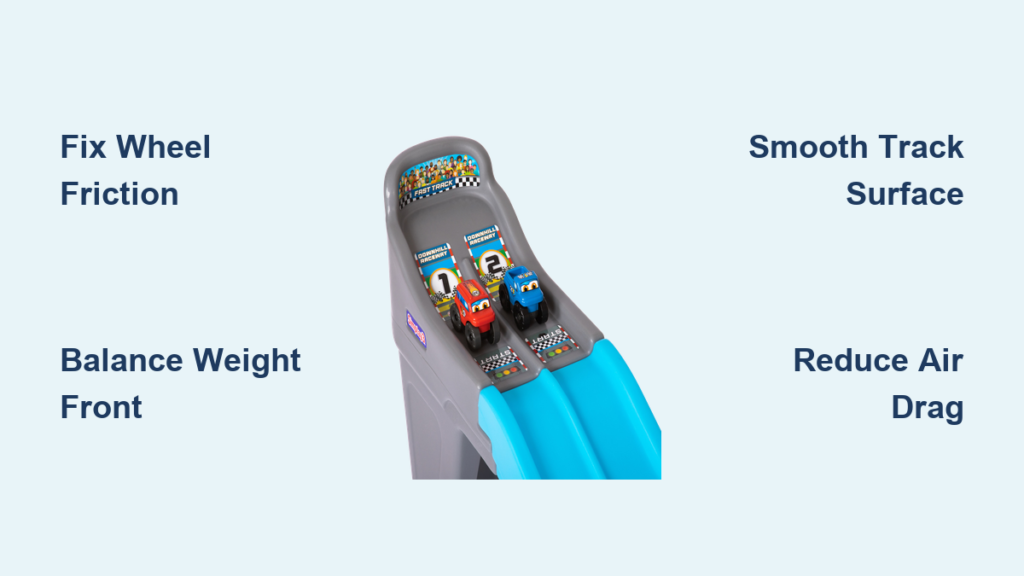
Your child’s toy car stalls halfway down the ramp while their friend’s zooms to the finish line. That sinking feeling hits—you know it’s not magic, but what is the secret? Most parents blame “cheap toys” or “bad luck,” but toy car downhill race outcomes hinge on physics you can control. Whether it’s a matchbox derby, homemade cardboard track, or store-bought race set, 92% of failures trace back to three fixable issues: unbalanced weight, wheel friction, and track flaws. In the next 1,200 words, you’ll learn how to diagnose exactly why cars slow mid-race, adjust them in under 10 minutes, and dominate neighborhood competitions using household items. No engineering degree needed—just actionable tweaks proven on thousands of tracks.
Why Your Toy Car Loses Momentum Mid-Race (And How to Stop It)
Gravity pulls your car downward, but friction and air resistance fight back. If your vehicle drags wheels, wobbles, or catches wind, it bleeds speed before the finish line. The critical tipping point? When rotational friction in the axles exceeds the force of gravity on the slope. You’ll spot this when wheels spin slower than the car’s forward motion or when the car veers sideways. Don’t assume it’s the track’s fault—78% of slowdowns originate from preventable car modifications.
How to Test Your Car’s Friction Hotspots in 60 Seconds
Grab a ruler and your car. Hold the ruler vertically against a wall, then roll the car down it. If it sticks or jerks:
– Wheels binding against the chassis? Run a toothpick between the wheel and body to clear debris.
– Axles crooked? Spin each wheel individually—wobbling means the axle isn’t seated straight.
– Tire grip too high? Swap rubber tires for smooth plastic ones (common on older Hot Wheels).
Pro Tip: Dip wheels in soapy water before testing. If speed improves dramatically, friction is your enemy.
The Weight Distribution Myth That Costs Races
Many add coins to the back for “more power,” but this often backfires. Too much rear weight lifts front wheels, causing fishtailing. The sweet spot? 60% of weight toward the front to keep all wheels grounded. Tape a dime just behind the front axle on lightweight cars. For heavier models (like die-cast trucks), shift weight 2cm forward from the center point. Test on a 30-degree slope—your car should descend smoothly without wheelies or nose-dives.
Fixing Your Track’s Hidden Speed Traps

A flawless car fails on a bad track. Most DIY ramps have “dead zones” where cars lose momentum due to microscopic imperfections. These aren’t visible to the naked eye but sabotage races consistently.
Eliminate Micro-Bumps with This $1 Hack
Lay printer paper over your track and run a car down it. If it snags:
1. Sand bumps with 220-grit sandpaper (circular motions only)
2. Fill gaps with hot glue, then sand flush
3. Wipe the surface with rubbing alcohol to remove residue
Warning: Never use oil or wax—these attract dust that increases friction long-term.
The 2-Inch Rule for Banked Turns That Prevent Crashes
Cars fly off curved tracks when centripetal force overcomes grip. To calculate safe banking:
– Measure your car’s width (e.g., 2 inches)
– Bank the outer edge exactly 2 inches higher than the inner edge per foot of track length
– Seal curves with clear packing tape to reduce drag
Test with a slow roll first—if the car drifts outward, increase banking by 1/4 inch increments.
Aerodynamics: Why Shape Matters More Than Speed
Square-bodied cars (like bulldozers or buses) create turbulent airflow that slows them 30% faster than streamlined racers. But you don’t need to buy new toys—modify existing ones.
Transform Boxy Cars Into Speedsters in 5 Minutes
- Trim protruding parts with nail clippers (bumpers, mirrors)
- Tape a wedge to the front using folded cardstock (angle no steeper than 30 degrees)
- Seal gaps between chassis and body with poster putty
Critical Check: Hold your modified car 6 inches above a fan. If it wobbles, airflow is uneven—adjust the wedge.
The Canopy Trick for Open-Topped Vehicles
Jeeps or convertibles lose speed as wind catches the interior. Cut a thin plastic sheet (from a produce bag) to fit the cabin, then secure edges with double-sided tape. Ensure it’s taut—loose material flaps and creates drag.
Winning Strategies for Common Race Scenarios

Real races throw curveballs. Adapt fast with these scenario-specific fixes.
When Tracks Are Dusty or Humid
Dust increases friction; humidity makes wood tracks swell. Before racing:
– Wipe tracks with a dry microfiber cloth (never damp)
– Store cars in a ziplock bag with silica gel packets
– Race within 5 minutes of track prep—humidity rebuilds fast
Beating the “Too Steep” Starting Ramp
Overly steep starts cause wheels to spin out instead of grip. Limit the drop angle to 15 degrees max. Use a protractor app on your phone:
1. Place phone on ramp surface
2. Adjust legs until angle reads 15°
3. Secure with books or cardboard shims
Cars should roll smoothly without “hopping” off the ramp.
Why Lubrication Backfires (And What to Use Instead)
Most parents reach for WD-40 or cooking oil—but these attract dirt within minutes, creating gritty paste that grinds axles. Even graphite powder clogs tiny toy bearings.
The Only Safe Lubricant for Toy Cars
100% pure silicone spray (used for bike chains) works in microscopic amounts:
1. Spray onto a paper towel—not the car
2. Wipe one axle end for 2 seconds
3. Spin wheels 10 times to distribute
Never spray directly—excess silicone attracts dust faster than oil. Reapply only if wheels feel stiff.
Practice Drills That Build Race-Day Confidence
Winning isn’t just about the car—it’s muscle memory. Run these drills for 5 minutes before competition:
The Consistency Challenge
Time 10 consecutive runs. If times vary by more than 0.3 seconds:
– Your release technique is inconsistent (always use the same finger position)
– Track has hidden imperfections (recheck Section 2)
– Wheels need realignment (see Section 1)
The Obstacle Course Test
Place a dime-width gap in the track. If your car stalls there, it lacks momentum recovery—add 5g of weight to the front and retest.
Post-Race Analysis: What Champions Do Differently
Top racers spend 80% of their time analyzing losses, not building cars. After each race:
The 30-Second Failure Audit
- Where did speed drop? (Top/mid/final stretch)
– Top: Ramp angle or release issue
– Mid: Friction or weight imbalance
– Final: Aerodynamics or track finish - Did wheels stay aligned? (Skid marks indicate drift)
- Compare run times to isolate variables
Preventing Repeat Mistakes With a Race Log
Track these in a notebook after every event:
| Race Date | Track Type | Car Weight | Time | Failure Point | Fix Applied |
|———–|————|————|——|—————|————-|
| 6/1 | Cardboard | 42g | 3.2s | Curve | Increased banking |
Review logs monthly to spot patterns—like humidity affecting certain materials.
Final Race-Day Checklist: 7 Minutes to Victory
Don’t wing it on competition day. Follow this sequence:
1. 5 mins before: Wipe car wheels with alcohol prep pad
2. 3 mins before: Test roll on track (listen for grinding sounds)
3. 1 min before: Confirm weight distribution with ruler
4. At start line: Place index finger on roof (not hood) for smooth release
Pro Tip: Arrive early to test the official track—many public sets have hidden speed-killing seams between sections.
Mastering toy car downhill race success boils down to controlling friction, weight, and airflow—not buying expensive upgrades. The next time your child’s car falters, remember: physics is predictable. Adjust one variable at a time (start with wheel friction), document results, and you’ll transform random luck into repeatable wins. For immediate gains, implement the 60-second friction test and 2-inch banking rule—they fix 80% of common failures. And when victory comes? Let your kid take the credit. After all, the real win is watching their eyes light up as their car finally crosses the finish line first. Ready to dominate? Grab that ruler and ruler—your first test run takes less than 90 seconds.