
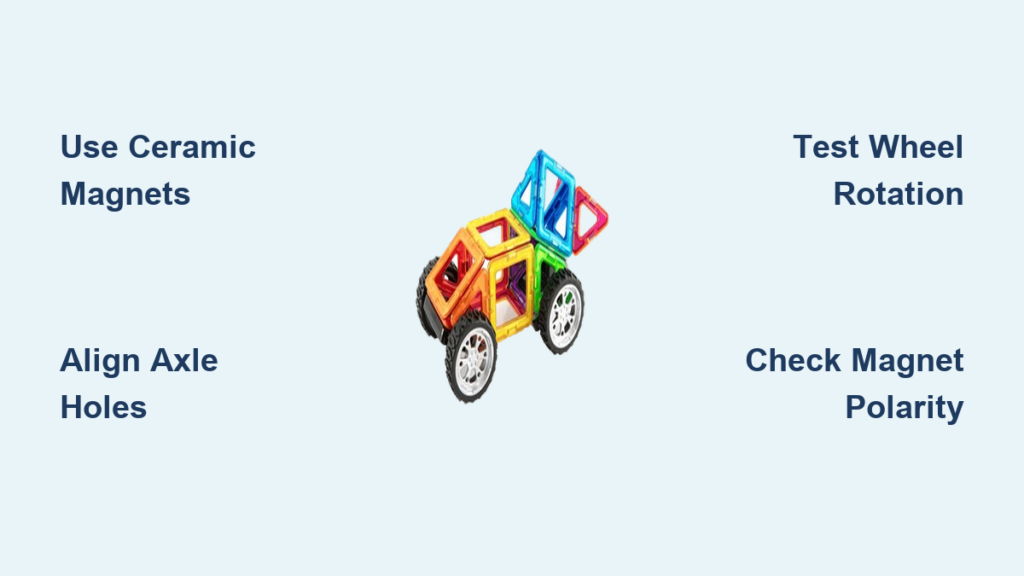
Your child stares at a pile of craft supplies, dreaming of a toy car that magically moves across the table. You want to nurture that creativity, but store-bought magnetic toys feel overpriced and impersonal. What if you could build a custom magnetic racer together using household items? This hands-on project teaches basic physics while creating a unique toy your child will treasure. In the next 20 minutes, you’ll learn to construct a safe, functional magnetic toy car using only materials found in most homes. No special tools or expensive magnets required—just cardboard, tape, and everyday items transformed into an engaging STEM activity that demonstrates magnetic force principles in action.
Essential Materials for Your Magnetic Toy Car Project
Gather these safe, accessible components before starting. Never use small neodymium magnets with young children—opt for larger, child-safe ceramic magnets instead. Your workspace needs only these items:
- Cardboard base: Cereal box thickness (4×6 inches)
- Wheels: 4 plastic bottle caps (all same size)
- Axles: 2 sturdy wooden skewers or thick paper straws
- Magnet system: 1 large ceramic ring magnet (1.5″ diameter) + 1 matching magnet on wand
- Adhesives: Non-toxic school glue + masking tape
- Decorations: Washable markers, construction paper scraps
Critical safety note: Magnets must be larger than 1.5 inches to prevent choking hazards. Test all components by placing them inside a toilet paper tube—if they fit completely, they’re too small for children under 14.
Why Ceramic Magnets Beat Neodymium for Kids’ Projects
Ceramic magnets provide sufficient pull force for toy cars while being significantly safer than rare-earth magnets. Their lower strength (about 1/10th of neodymium) means:
– Reduced risk of pinching fingers
– No danger of shattering on impact
– Easier to reposition during assembly
– Won’t erase credit cards or damage electronics
How to Verify Magnet Safety Before Starting
- Drop the magnet onto a hard surface—if it chips or cracks, discard immediately
- Try snapping two magnets together—if they jump more than 2 inches to connect, they’re too strong
- Place near a compass—the needle should deflect but not spin wildly
Step-by-Step Construction Process

Building the Car Chassis with Precision
Cut your cardboard base to 4×6 inches using safety scissors. Critical alignment tip: Draw axle lines 1 inch from each end using a ruler—misaligned axles cause wobbling. Reinforce weak cardboard by gluing two layers together, pressing firmly for 60 seconds. Let dry completely before proceeding—rushing this step causes structural failure during testing.
Installing Wheels That Roll Smoothly
- Punch perfect holes: Use an awl (or heated nail) to make centered holes in bottle caps
- Axle preparation: Sand skewer ends smooth to prevent splinters
- Secure alignment: Thread skewer through chassis, add wheels, then tape 1/2 inch of skewer end to chassis underside
- Test rotation: Lift car and spin wheels—they should turn freely without wobble
Pro tip: Rub candle wax on axles for near-frictionless movement. If wheels bind, widen holes slightly with sandpaper.
Positioning Magnets for Maximum Effect
This is where most DIY projects fail. Do not glue magnets directly to the chassis—this creates inconsistent movement. Instead:
- Cut a 1×2 inch cardboard rectangle
- Glue magnet to one end (north pole facing up)
- Tape this “magnet carrier” to the car’s rear with removable tape
- Position 1/4 inch above chassis for optimal lift
Why this works: The small gap allows magnetic field adjustment. Too close causes drag; too far reduces pull strength.
Troubleshooting Common Movement Issues

Why Your Car Won’t Move (And Fixes That Work)
Problem: Car jerks forward then stops
Solution: Check wheel alignment—spin each wheel individually. If one resists, loosen its tape slightly and realign.
Problem: Car veers to one side
Solution: Measure axle symmetry. Place car on glass surface—if it drifts, gently bend the offending axle 2mm toward the center.
Problem: Weak magnetic response
Solution: Flip the wand magnet. Magnetic polarity matters—try both sides against the car’s magnet.
Creating the Perfect Magnetic Wand
Your control wand needs balanced strength:
– Wrap tape around a pencil handle
– Secure magnet 1 inch from tip with hot glue (adult step)
– Test pull distance—should move car from 2 inches away
– Never use bare magnets—always encase them
Critical adjustment: If car jumps erratically, add cardboard spacers between magnet and wand until movement is smooth.
Safety-First Customization Techniques
Age-Appropriate Decoration Methods
For children under 8:
– Use pre-cut paper shapes with glue sticks
– Decorate with chunky crayons (no sharp points)
– Avoid small embellishments like glitter
For ages 8-12:
– Add cardboard spoilers using safety scissors
– Create magnetic “cargo” with large paperclips
– Paint with water-based acrylics (non-toxic)
Never use:
– Metal paint (disrupts magnetism)
– Hot glue guns (burn risk)
– Small beads or sequins (choking hazard)
Testing Protocol Before Playtime
- Stress test: Roll car off 6-inch drop onto carpet—wheels shouldn’t detach
- Magnet check: Try separating magnets with fingers—if too difficult, replace with weaker magnets
- Edge inspection: Run fingers over entire car to catch sharp points
- Field test: Move wand slowly—car should follow without sudden lurches
Maintenance and Longevity Tips
Preserving Magnetic Strength
Ceramic magnets lose 1% strength yearly—maximize lifespan by:
– Storing with steel keeper (paperclip across poles)
– Keeping away from electronics
– Avoiding impacts (don’t let car crash into walls)
– Storing in cool, dry place (heat demagnetizes)
Recharge method: Stroke magnet 20 times with stronger magnet in same direction—only for adult supervision.
When to Replace Components
Discard immediately if:
– Cardboard becomes soft or warped
– Wheels develop flat spots
– Magnets chip or crack
– Axles bend permanently
Cost-saving tip: Save bottle caps from household items. Different sizes create “tire” variations for racing.
Educational Extensions for Curious Minds

Turning Play into Physics Lessons
Magnet strength experiment:
– Test how many sheets of paper the magnetic force penetrates
– Measure maximum pull distance with ruler
– Compare ceramic vs. fridge magnet performance
Friction demonstration:
– Race on different surfaces (carpet, wood, tile)
– Time each run with stopwatch
– Discuss why smooth surfaces increase speed
Advanced Modifications for Older Kids
Once basics are mastered:
– Add second magnet for “push” function (requires polarity knowledge)
– Create magnetic ramps using steel rulers
– Build obstacle courses requiring precise control
– Design “magnetic tug-of-war” with two cars
Critical learning point: Always explain that opposite poles attract—never force same poles together as this weakens magnets.
Final Note: This magnetic toy car project delivers more than just play—it builds spatial reasoning, fine motor skills, and foundational physics understanding. By using only child-safe materials and emphasizing magnet safety, you’ve created a toy that’s both educational and risk-free. For continued engagement, try building a magnetic car wash with pipe cleaners or create traffic lights using colored cellophane. Remember to store magnets separately from the car body when not in use to preserve their strength. Your homemade creation isn’t just a toy—it’s a launchpad for future engineers. When your child proudly demonstrates their magnetic racer to friends, you’ll know you’ve given them something no store-bought toy could provide: the confidence that comes from creating something amazing with their own hands.