
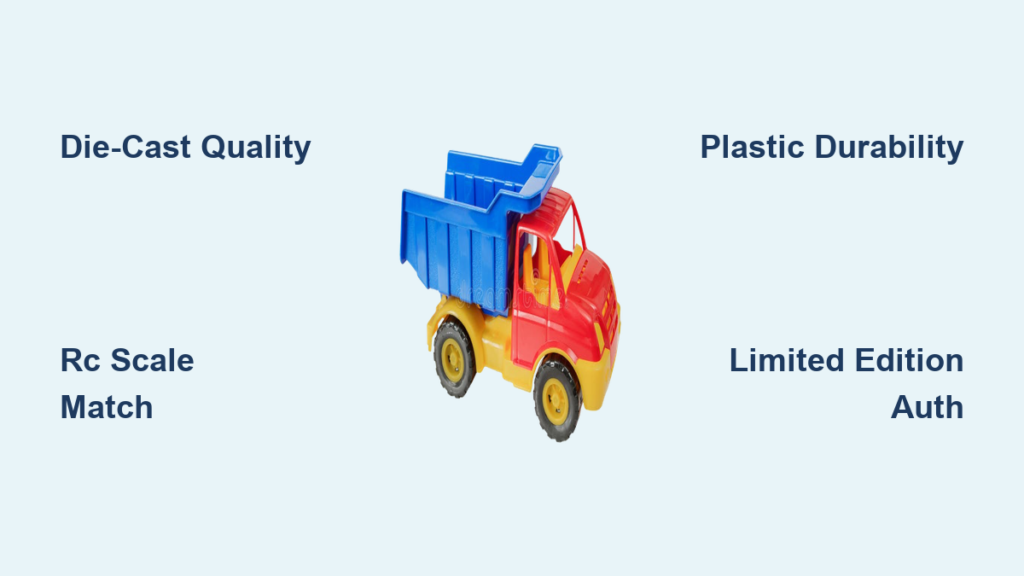
When your child’s plastic dump truck breaks for the third time this month or you’re staring at a vintage Lesney Products model wondering if it’s worth collecting, understanding the different types of toy trucks becomes essential. The world of toy trucks spans from simple pull-along wooden models to intricate 1:12 scale replicas that cost hundreds of dollars, with collectors spending millions annually on rare finds. Whether you’re shopping for a toddler’s first vehicle or building a museum-worthy display, knowing the distinct categories helps you avoid costly mistakes and find exactly what you need. This guide breaks down eight critical types of toy trucks that dominate the market, highlighting their unique features, value indicators, and which ones actually hold their worth over time.
Identify High-Quality Die-Cast Toy Trucks From Budget Imitations
Die-cast toy trucks stand apart through their zinc alloy construction that delivers unmatched weight and detail compared to plastic alternatives. When examining potential purchases, check for crisp panel lines, properly aligned doors and hoods, and rubber tires that don’t crack after minimal handling. Brands like Bburago, Maisto, and Ertl Company consistently deliver quality across their 1:18, 1:24, and 1:64 scale offerings, while budget imitations often feature blurry logos and flimsy attachments that break during normal play.
Spot These 3 Signs of Premium Die-Cast Construction
Look for these critical quality indicators before adding die-cast trucks to your collection:
- Seam quality: Authentic pieces show minimal mold lines along body panels
- Paint adherence: High-end models feature paint that won’t chip when rubbed with a fingernail
- Weight distribution: Quality trucks feel substantial (typically 3-8 ounces for 1:64 scale)
Vintage collectors prize Dinky Toys and early Lesney Products models for their historical significance, with certain limited editions fetching thousands at auction. Modern collectors should examine packaging carefully—original boxes in good condition can double or triple a model’s value, especially for brands like Greenlight Collectibles and Exclusive First Editions that produce licensed replicas of real-world trucks.
Choose the Best Radio-Controlled Toy Truck for Your Skill Level
Radio-controlled toy trucks transform playtime into an engaging hobby that combines driving skill with technical understanding. Entry-level models from New Bright operate on basic 27 MHz frequencies with limited range (50-100 feet), while advanced enthusiasts prefer 2.4 GHz systems from Tamiya Corporation offering precise control up to 300 feet. Off-road RC trucks require different considerations than on-road models—look for waterproof electronics, four-wheel drive systems, and oil-filled shocks if you plan outdoor adventures.
Avoid These 3 Common RC Truck Buying Mistakes
Newcomers frequently waste money on incompatible or unsuitable RC trucks:
- Battery confusion: Nickel-metal hydride (NiMH) batteries require different chargers than lithium-polymer (LiPo)
- Scale mismatch: 1:16 trucks need significantly more space than 1:24 models
- Frequency conflicts: Multiple 27 MHz trucks operating nearby will interfere with each other
Tamiya Radio Controlled Nitro Vehicles represent the premium segment, with nitro-powered engines requiring maintenance skills beyond simple electric models. For beginners, consider starter packages from brands like Jada Toys that include everything needed to begin driving immediately. Serious collectors should track limited releases like US-1 Trucks, which command premium prices once discontinued.
Dominate Slot Car Racing With These 3 Specialized Toy Truck Types

Slot car racing trucks offer competitive fun that’s accessible to all ages but requires understanding the different vehicle types designed for specific track configurations. Scalextric and Carrera dominate the modern market, but vintage AFX and Aurora models remain popular among enthusiasts. Unlike radio-controlled trucks, slot cars rely on guide pins that fit into track grooves, eliminating steering control but creating unique racing challenges based on throttle management and lane selection.
Match Your Truck Type to Track Configuration
Different slot car trucks excel on specific track layouts:
- Straight-speed trucks: Optimized for oval tracks with minimal turns
- Cornering specialists: Feature lower centers of gravity for banked curves
- Multi-lane racers: Designed specifically for tracks with crossover sections
Collectors should examine the motor type when evaluating vintage slot trucks—older models with wound-field motors often outperform modern equivalents with simpler can motors. The rarest pieces include limited edition releases from manufacturers like Husky and Funmate that featured working lights or sound effects, which significantly increase in value when found in original packaging.
Test Your Plastic Toy Truck’s Durability: 4 Critical Stress Points
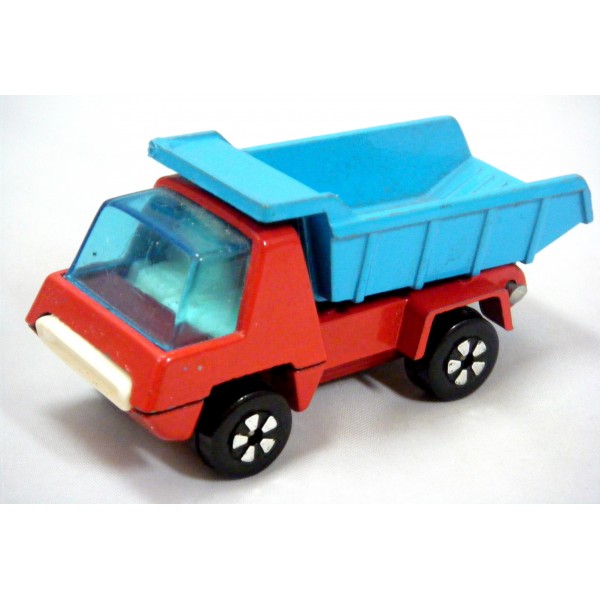
Modern plastic toy trucks from brands like Playart and Majorette offer surprising durability when properly engineered, but not all withstand rough play equally. ABS plastic construction provides the best balance of flexibility and strength, while cheaper polystyrene models crack easily under pressure. When evaluating potential purchases, specifically test these four structural weak points that commonly fail:
- Axle attachment points: Press down firmly on each corner to check for wobbling
- Hinge mechanisms: Open and close tailgates or doors repeatedly
- Undercarriage clearance: Ensure no plastic nubs will break during floor play
- Paint adhesion: Rub logos gently with a damp cloth to test for peeling
Vintage pressed steel trucks from Hubley Manufacturing Company and Buddy “L” represent the historical bridge between early metal toys and modern plastic alternatives. While heavier and more expensive than plastic equivalents, their all-metal construction withstands decades of use when properly maintained. Collectors should watch for rust on these vintage pieces, which significantly reduces value even when other aspects remain pristine.
Identify 7 Classic Toy Truck Brands That Appreciate in Value

Certain toy truck manufacturers have built reputations that transcend generations, creating pieces that increase in value over time. Lesney Products’ Matchbox trucks from the 1960s-1980s remain the gold standard for vintage collectors, with rare models like the Dinky Toys Mercedes-Benz Setra bus selling for thousands. Modern equivalents like Hot Wheels’ Premium and Elite64 series deliberately target adult collectors with enhanced detail and limited production runs.
Track These 3 Brands Showing Strong Market Growth
Recent auction data reveals these manufacturers gaining significant collector interest:
- Tamiya Corporation: Their precision engineering commands premium prices
- Greenlight Collectibles: Licensed replicas of real trucking companies
- Hess toys: Holiday releases now considered valuable collectibles
The most valuable pieces often feature original packaging in excellent condition, with complete documentation adding 30-50% to market value. Collector communities closely monitor production numbers—limited runs of 5,000 units or fewer typically appreciate fastest, especially when associated with major brands like Peterbilt or Kenworth.
Match Toy Truck Scales to Your Display Space: Size Comparison Guide

Understanding scale measurements prevents costly mistakes when building a cohesive collection. The 1:64 scale dominates retail shelves (Hot Wheels, Matchbox), while 1:18 scale offers dramatic detail at display-case friendly sizes. Serious collectors often specialize in one scale to maintain visual consistency, though some create dynamic scenes combining multiple scales for dramatic effect.
Choose Your Primary Scale Based on These Factors
Consider these practical aspects when selecting your collection’s scale:
- Display space: 1:12 scale trucks require 4x the linear space of 1:48 models
- Budget: Larger scales typically cost 3-5x more than smaller equivalents
- Detail appreciation: Scales larger than 1:24 show interior details visible without magnification
- Play value: Scales between 1:43 and 1:64 work best for interactive playsets
Online collector communities provide scale comparison charts showing exact dimensions for popular models. When mixing scales, maintain proportional consistency—combining 1:18 and 1:24 works visually, but 1:18 next to 1:64 creates jarring size discrepancies that diminish display quality.
Spot Authentic Limited Edition Toy Trucks: 5 Red Flags for Counterfeits
Limited edition toy trucks represent some of the fastest-appreciating segments of the market, but counterfeiters have become increasingly sophisticated. Genuine pieces from Exclusive First Editions and similar premium brands feature specific hallmarks that distinguish them from knockoffs. Always verify authenticity through multiple channels before making significant investments in limited releases.
Verify These Critical Authentication Points
Check these five elements when evaluating limited edition trucks:
- Certificate of authenticity: Should include matching serial numbers on both certificate and vehicle
- Packaging details: Official releases feature crisp printing with no spelling errors
- Material quality: Counterfeits often use brittle plastic and thin metal
- Color accuracy: Compare to verified images of authentic pieces
- Distribution channels: Limited editions rarely appear on mass-market discount sites
The most valuable limited editions often commemorate specific events or anniversaries, with production numbers clearly stated on packaging. Collectors should maintain purchase records and original packaging to maximize future resale value, as provenance documentation significantly impacts premium collectibles.
Start Your Toy Truck Collection Right: 7 Costly New Collector Mistakes
Building a valuable toy truck collection requires strategic planning to avoid common pitfalls that drain budgets and diminish enjoyment. Many newcomers make emotional purchases based on childhood nostalgia rather than objective value assessment, while others spread resources too thin across multiple categories without developing expertise in any single area.
Implement These Collection-Building Strategies
Adopt these proven approaches to build a meaningful collection:
- Specialize early: Focus on one manufacturer, era, or truck type
- Set budget limits: Allocate specific amounts for different quality tiers
- Join collector communities: Learn from experienced enthusiasts
- Document acquisitions: Maintain records of purchase price and condition
- Prioritize preservation: Invest in proper storage solutions immediately
The most successful collectors treat their hobby as a long-term investment in enjoyment rather than pure financial gain. Whether you’re drawn to the engineering of Tamiya RC trucks or the historical significance of vintage Dinky Toys, understanding these distinct types of toy trucks ensures you build a collection that brings lasting satisfaction rather than regrettable purchases.