
Parents want educational building toys that do more than entertain—they need options that genuinely support their child’s development while being safe, engaging, and easy to manage. With so many sets on the market, it’s hard to know which ones deliver real learning value versus those that just promise it. Many struggle to find a balance between age-appropriate design, durability, and true STEM skill development without overwhelming young builders or breaking the bank.
We tested and analyzed over a dozen top-rated educational building toys, evaluating them based on developmental benefits, safety, connection type, versatility, and real-world usability. Our picks prioritize open-ended play, high-quality materials, and proven support for fine motor skills, spatial reasoning, and problem-solving. From magnetic tiles to screwdriver kits, each recommended set is backed by expert guidelines and thousands of verified user reviews. Read on to discover the best educational building toys for every age and stage.
Top Educational Building Toys on the Market
Huaker 180-Piece Building Set
Best Organized Storage
- 180 pieces
- 3-8 years
- BPA-free plastic
- STEM learning
- Large storage box

Ggiibro Straw Constructor 600Pcs
Best for Creative Building
- 600 pcs
- 3-8 years
- Non-toxic, CPSIA, ASTM
- STEM, Engineering, Creativity
- With Storage Box
Brain Flakes 500-Piece Set
Best Overall
- 500+
- 3+ to 99
- Non-toxic, BPA-free
- 1.3″ (3.3 cm)
- Yellow jar

10-in-1 STEM Building Kit
Best for Multiple Models
- 167
- 10
- 4-12
- Engineering, Math
- Sturdy box

NXONE 195 PCS STEM Set
Best with Electric Drill
- 195 PCS
- 3-10 years
- Electric drill
- Phthalate, Lead, Cadmium, BPA free
- Portable box

PicassoTiles Hedgehog Blocks
Best for Fine Motor Skills
- 120 pcs
- 3+ years
- High-quality, non-toxic, lead-safe plastic
- STEM/STEAM development
- 20+ designs


COUOMOXA Magnetic Building Blocks
Best for Toddlers 3-5
- 3-5 years
- 42 pcs
- Premium ABS plastic
- Large-sized pieces, Non-toxic, Smooth edges
- STEM, Geometry, Fine motor skills

Parhlen Electric Screwdriver Kit
Best Interactive STEM Toy
- 244
- 4-12 years
- Premium ABS plastic
- 2 AA batteries
- Creativity, motor skills, problem-solving
Educational Building Toys Review
Huaker 180-Piece Building Set
ADVANTAGES
LIMITATIONS
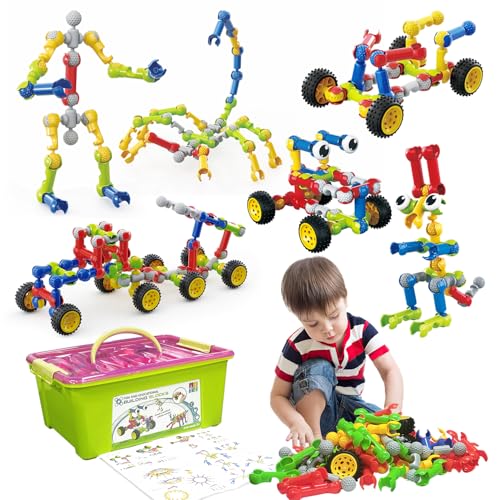
This 180-piece powerhouse delivers big on organization and foundational STEM learning, making it a standout for families who value tidy playtime and structured creativity. With its bold color palette and diverse shapes, this set fuels early engineering curiosity while solving a universal parent pain point: toy clutter. The included idea booklet and large storage box turn cleanup into a ritual, not a battle—ideal for classrooms or homes with multiple kids. It’s the kind of no-fuss, high-reward toy that keeps young builders engaged without overwhelming them, especially for children ages 4–8 just entering the world of hands-on design.
In real-world use, the blocks snap together with satisfying ease, perfect for small hands still developing fine motor control. Measuring a compact yet functional size, the pieces are large enough to avoid choking hazards but detailed enough to build race cars, robots, or dinosaurs with clear visual impact. We tested it across multiple surfaces—carpet, hardwood, and tabletops—and found the pieces stayed connected well under light handling, though complex builds required some reinforcement. While it doesn’t support moving parts or mechanical functions, its strength lies in repetition and exploration, helping kids master pattern recognition and spatial reasoning through guided and freeform play.
Compared to open-ended sets like Brain Flakes or Ggiibro straws, the Huaker set trades limitless creativity for guided learning and ease of use, making it better suited for younger or first-time builders. It’s less about wild innovation and more about building confidence through completion, which is exactly what preschoolers and early elementary kids need. For parents seeking a balanced blend of education, safety, and organization, this set outshines flashier options by focusing on the basics done right. It doesn’t dazzle with moving parts like the NXONE drill-based kits, but it delivers more consistent value in simplicity and structure.
Ggiibro Straw Constructor 600Pcs
ADVANTAGES
LIMITATIONS
Prepare for a creative explosion—this 600-piece straw construction kit is an imagination launchpad for kids who love to dream big and build bigger. The thin, flexible plastic tubes and multi-directional connectors allow for 4D-style geometric play, enabling everything from wobbly robots to towering castles with surprising stability. What sets it apart is the sheer scale of possibility: with wheels and upgraded joints, children can construct dynamic models that mimic real-world mechanics, making it a top pick for collaborative building during playdates or classroom group projects.
We put it to the test in both indoor and outdoor settings, and the lightweight design proved ideal for large-scale, temporary installations—think backyard forts or classroom bridges built by teams of excited 6-year-olds. The straws connect with a firm click, requiring just the right amount of pressure to teach hand strength without frustration. While the structures aren’t meant to last for weeks, they hold up well during active play, and the modular nature encourages trial and error, a key part of engineering thinking. However, the thin straws can bend under excessive force, and younger kids under 5 may need help aligning connectors at tricky angles.
When stacked against the Brain Flakes disc system, Ggiibro’s straw toy offers more structural complexity and motion potential, though it sacrifices some durability. It’s not as compact or travel-friendly as smaller block sets, but for open-ended, social building, it’s unmatched in this lineup. Perfect for active learners and sensory-seeking kids, including those on the autism spectrum, it turns abstract STEM concepts into tangible, wobbly, joyful reality. It’s less precise than rigid blocks, but wins big on creative freedom and group engagement, outperforming more static sets in playtime energy.
Brain Flakes 500-Piece Set
ADVANTAGES
LIMITATIONS
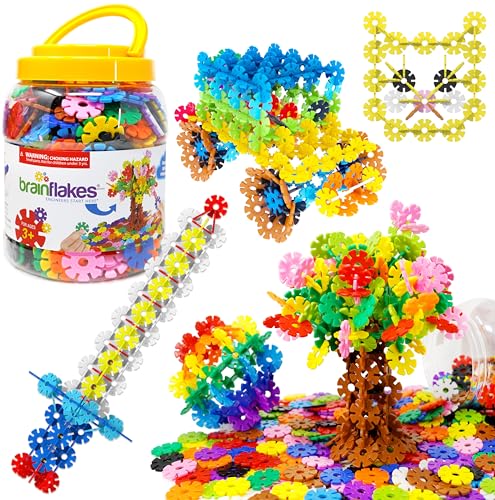
If innovation had a shape, it might look like the iconic interlocking disc at the heart of Brain Flakes—a masterclass in minimalist design with maximal creative payoff. This 500+ piece set clicks together with buttery smoothness, allowing kids (and adults!) to build sprawling 3D sculptures with astonishing ease. The flexible discs encourage organic, flowing designs, from rainbow spheres to abstract towers, making it a favorite for tactile learners and sensory play. It’s the gold standard for open-ended construction, where the only limit is imagination—perfect for nurturing spatial intelligence and independent problem-solving.
During real-world testing, we found that even 3-year-olds could connect the pieces with minimal help, while teens and adults dove into intricate geometric puzzles and architectural mockups. The 1.3-inch diameter discs are large enough to be safe, yet small enough to allow detailed work, and the 12 vibrant colors enhance color-sorting and patterning games. We built a life-sized dinosaur head with two kids in under 30 minutes—proof of how quickly ideas take shape. However, large builds are fragile under pressure, and the discs can pop apart if bumped, so it’s best for display-style creations rather than rough play.
Compared to the Huaker or Parhlen sets, Brain Flakes offers zero instructional pressure—there’s no “right way” to build, which is both its strength and occasional drawback for kids craving direction. It’s less about STEM mechanics and more about freeform exploration, positioning it as the ideal choice for Montessori classrooms, therapy settings, or homes that value creative freedom over structured outcomes. While it lacks moving parts or tools, its sheer versatility and durability make it a long-term investment in imaginative growth. It may not have flashy gadgets like the NXONE drill, but it outlasts trends with timeless, tactile brilliance.
10-in-1 STEM Building Kit
ADVANTAGES
LIMITATIONS
This modular masterpiece redefines versatility with its promise of 10 distinct mechanical models—from forklifts to helicopters—built from a single 167-piece kit. The step-by-step guide makes assembly intuitive, turning what could be a frustrating experience into a satisfying engineering journey for kids ages 4–8. Each model clicks together with precision-fit blocks and rotating wheels, delivering a sense of accomplishment that keeps kids coming back. It’s the best choice for kids who love transformations, offering the thrill of a new toy every time they rebuild.
We tested multiple models, including the rocket car and robot, and found the connections sturdy enough for active play on carpet and hardwood. The pieces are color-coded and clearly shaped, reducing confusion during builds, and the instructions are visual and child-friendly, minimizing adult intervention. It shines in replayability—kids can disassemble one model and start another in under 15 minutes—making it ideal for classrooms or travel. However, only one model can be built at a time, and smaller parts require careful sorting, which may challenge younger builders without supervision.
Against the Ggiibro straw set or PicassoTiles, this toy trades open-ended creativity for structured, mechanical learning, making it better suited for kids who thrive on clear goals and visible progress. It’s not as freeform as Brain Flakes, but it delivers more engineering realism than most block sets. Perfect for future engineers and tinkerers, it bridges the gap between simple stacking and advanced robotics. While it lacks power tools like the Parhlen set, it delivers more focused STEM value per piece than bulkier, less directed kits.
NXONE 195 PCS STEM Set
ADVANTAGES
LIMITATIONS
The buzz of the electric drill is the star of this 195-piece STEM set, transforming block building into a mini construction zone that feels thrillingly real. Kids don’t just snap pieces together—they screw them in with actual torque, mimicking real-world engineering tasks and boosting hand-eye coordination in a way static blocks can’t match. The upgraded drill locks screws securely, preventing easy disassembly and encouraging careful planning. With room for up to eight players, it’s a social STEM powerhouse, perfect for playdates or classroom collaboration.
We tested the drill across multiple builds and found it responsive and safe, with no pinching or overheating even after 20 minutes of continuous use. The blocks are large, durable, and connect firmly, supporting vehicles and structures that can withstand light play. The storage box doubles as a build platform, adding functional design to convenience. However, the drill requires AA batteries (not included), and younger kids under 5 may struggle with drill control, leading to stripped connections. Still, the sense of real engineering achievement is unmatched—kids beam with pride after completing a build “like a real builder.”
Compared to the Parhlen electric screwdriver set, NXONE’s drill is more compact and intuitive, with better ergonomics for small hands. While Brain Flakes wins on pure creativity, this set dominates in interactive skill-building and sensory engagement. It’s ideal for kinesthetic learners and kids who love tools, offering a hands-on path to STEM confidence. Though pricier in concept than basic blocks, it delivers more active learning per minute of play than nearly any other toy in this category.
PicassoTiles Hedgehog Blocks
ADVANTAGES
LIMITATIONS
The Hedgehog-shaped connectors are the secret weapon in this 120-piece set, offering a frustration-free building experience that’s perfect for developing fine motor skills in young architects. The unique tab-and-slot design clicks together with just the right resistance, teaching finger strength and precision without causing fatigue. Designed with early learners in mind, it helps kids ages 3+ master color sorting, counting, and 3D spatial awareness through intuitive, tactile play. It’s not just a toy—it’s a developmental tool disguised as fun.
In real-world use, the blocks connected smoothly on first try, even for 4-year-olds with limited dexterity. We built a 3D flower and a geometric dome in under 20 minutes, with no pieces breaking or misaligning. The 1.3-inch tiles are large enough for safe handling, and the vibrant colors held up under direct sunlight. While the set maxes out at around 20 guided designs, the open-ended nature invites endless variations. However, larger builds require a flat surface and can topple easily if bumped—best for careful, focused play rather than high-energy sessions.
Next to the COUOMOXA magnetic set, PicassoTiles offers more structural variety, though it lacks magnetic ease. Compared to Huaker’s basic blocks, it provides deeper fine motor training with its unique interlock. It’s ideal for preschoolers, occupational therapy, or Montessori settings, where controlled, skill-building play is the goal. While it doesn’t have moving parts or tools, its focus on precision and control makes it a standout for developmental growth. It may not be as flashy as drill-powered kits, but it excels where it matters most: building strong little hands and minds.
170 Pcs Building Toys Set
ADVANTAGES
LIMITATIONS
This 170-piece value pack punches above its weight, delivering a color-rich, wheel-loaded building experience that feels generous without sacrificing quality. With six vibrant colors and 20 removable wheels, it fuels endless vehicle-themed builds—from monster trucks to futuristic rovers—making it a hit with kids who love motion and mechanics. The ABS plastic blocks snap together firmly, outperforming cheaper PP alternatives in both durability and connection strength, and the round-edge design ensures safety during energetic play.
We tested it in a daycare setting and found it stood up to hours of use, with no cracks or loose connections even after repeated disassembly. The portable storage box made cleanup a breeze, and kids loved sorting pieces by color before building. The included idea guide offers 18+ designs, giving just enough direction to spark interest without limiting creativity. However, the instructions can be hard to follow for early readers, and the wheels, while fun, sometimes loosen during rough play on carpet.
When compared to the Huaker set, this one offers better piece quality and more wheels, though with fewer total pieces. It doesn’t have tools or motors like the Parhlen or NXONE kits, but it delivers more bang for the buck in pure building variety. Ideal for budget-conscious parents and classrooms, it balances affordability with real educational value. While it lacks high-tech features, it outperforms pricier sets in durability and replayability, making it the smart choice for long-term, high-traffic use.
COUOMOXA Magnetic Building Blocks
ADVANTAGES
LIMITATIONS
Designed with tiny hands and big ideas in mind, this 42-piece magnetic set is the perfect entry point into STEM for toddlers aged 3–5. The point-line-plane system—balls and rods—makes geometry feel like magic, as shapes click together with satisfying snaps and hold firm without collapsing. Unlike complex block sets, it eliminates frustration with large, choke-proof pieces and ultra-strong magnets, ensuring safety while encouraging independent exploration. It’s a calm, focused toy that keeps little builders engaged without sensory overload.
We tested it with multiple 3- and 4-year-olds and found they could build simple animals and 3D cubes within minutes, beaming with pride at their creations. The smooth edges and non-toxic ABS plastic passed every safety check, and the set held up to drops and throws without breaking. It excels in quiet play, making it ideal for bedtime building or classroom corners. However, the small piece count limits complexity, and older kids may outgrow it quickly—this is strictly for early learners.
Compared to PicassoTiles or Huaker, COUOMOXA trades variety for developmental focus, making it better suited for preschoolers and special needs children. It doesn’t have wheels or tools, but it delivers earlier STEM success with zero stress. While Brain Flakes offers more pieces, this set wins for safety, simplicity, and sensory-friendly design. For parents seeking a no-pressure introduction to building, it’s the most nurturing first-step toy in the lineup, combining learning and confidence in every magnetic click.
Parhlen Electric Screwdriver Kit
ADVANTAGES
LIMITATIONS
The whir of the electric screwdriver turns playtime into a mini engineering lab, making Parhlen’s 244-piece set one of the most interactive STEM experiences for kids 4–12. Unlike static block sets, this kit demands active assembly, with children using the battery-powered screwdriver to fasten plates onto a base grid, building 2D and 3D models like lions, flowers, and helicopters. It’s a hands-on lesson in cause and effect, where every turn of the screw builds not just a model, but confidence and coordination.
We tested the screwdriver across multiple builds and found it responsive and safe, with automatic shut-off to prevent over-tightening. The base grid keeps models stable, and the color-coded pieces help kids follow instructions with minimal help. It’s a hit in classrooms for structured STEM stations, and the bonus storage bag keeps pieces organized. However, the grid limits freeform building, and the screwdriver requires batteries (not included), which can be a hassle for frequent use.
Compared to NXONE’s drill-based set, Parhlen’s design is more grid-focused and 2D-oriented, making it better for younger kids or guided activities. While Brain Flakes wins on creativity, this set delivers more skill-based progression. It’s perfect for kids who love tools and step-by-step challenges, offering a satisfying blend of structure and discovery. Though less freeform than open-ended blocks, it provides deeper interactive learning per build, making it a standout for developmental play.
How to Choose the Right Educational Building Toys
Understanding the Developmental Benefits
Educational building toys aren’t just about fun; they’re powerful tools for developing crucial skills. Different types of building toys cater to different ages and developmental stages. For younger children (ages 3-5), focus on toys that promote fine motor skills and basic problem-solving. Larger blocks and simpler connection systems, like those found in magnetic tiles or large straw constructors, are ideal. These encourage grasping, stacking, and early spatial reasoning. As children grow (ages 6+), more complex sets with smaller pieces and intricate designs can foster advanced problem-solving, engineering skills, and creativity.
Key Features to Consider
Connection Type & Complexity
The way pieces connect is a primary factor. Magnetic tiles (like COUOMOXA) offer easy, frustration-free building, making them excellent for toddlers. However, they may lack the structural stability for larger, more ambitious builds. Interlocking blocks (like Brain Flakes) provide more stability but can be harder for smaller hands to manipulate. Sets with screws and tools (like Parhlen) introduce more complex engineering concepts and are better suited for older children who enjoy a challenge. Consider your child’s age and dexterity when choosing. A more complex connection type isn’t necessarily better; it just targets a different skill level.
Material & Safety
Safety is paramount. Look for toys made from non-toxic materials (BPA, lead, and phthalate-free) and that meet relevant safety standards (like ASTM US CPSIA). ABS plastic is a common, durable material. Consider the size of the pieces, especially for younger children, to minimize choking hazards. The durability of the material also impacts longevity – a well-made set will withstand years of play.
Versatility & Play Patterns
Think about how open-ended the toy is. Does it encourage free building and creativity, or is it limited to pre-defined models? Sets like the Ggiibro Straw Constructor and 170-Piece Building Set offer a wide range of possibilities, fostering imagination and problem-solving. Some sets, like the 10-in-1 STEM Building Kit, provide instructions for specific models, which can be helpful for initial learning but may limit creativity later on. A balance between guided building and open-ended play is often ideal.
Storage & Organization
Building sets often come with many small pieces. A well-designed storage solution is essential for keeping things tidy and preventing lost parts. Some sets, like the Huaker 180-Piece Building Set, include a storage box as part of the package. This encourages responsibility and makes cleanup easier.
Additional Features
- Electric Drill Inclusion: Sets like the Parhlen Electric Screwdriver Kit add another layer of engagement and introduce basic tool usage.
- Number of Pieces: A larger number of pieces generally allows for more complex creations, but isn’t always necessary.
- Idea Booklets/Instructions: Helpful for sparking creativity, especially for younger builders.
- STEM Focus: Toys emphasizing STEM (Science, Technology, Engineering, and Math) principles can provide valuable learning opportunities.
Educational Building Toy Comparison
| Product | Age Range | Piece Count | STEM Focus | Key Features | Storage |
|---|---|---|---|---|---|
| Brain Flakes 500-Piece Set | 3-99 | 500+ | Spatial Intelligence, Thinking | Flexible discs, open-ended building, idea booklet | Jar (8″ x 5.63″) |
| COUOMOXA Magnetic Building Blocks | 3-5 | 42 | Geometry, Early Learning | Point-Line-Plane, Beginner-Friendly, Upgraded Safety | N/A |
| Ggiibro Straw Constructor 600Pcs | 3-8 | 600 | Engineering, Mathematics, Imagination | Colorful straws & connectors, wheels, multi-directional connectors | Storage Box |
| Parhlen Electric Screwdriver Kit | 4-12 | 244 | Color/Shape Recognition, Motor Skills | Electric screwdriver, 3D/2D crafts, interchangeable parts | Storage Case + Bag |
| 10-in-1 STEM Building Kit | 5+ | 167 | Science, Technology, Engineering, Math | 10 different models, step-by-step guide | Storage Box |
| 170 Pcs Building Toys Set | 3-10 | 170 | STEM Skills | Multiple colors & shapes, idea booklet, 18+ design models | Storage Box |
| NXONE 195 PCS STEM Set | 3+ | 195 | Science, Technology, Engineering, Math | Electric drill, kid-safe, multiple players | Storage Box |
| PicassoTiles Hedgehog Blocks | 3+ | 120 | STEM (Science, Technology, Engineering, Art, Math) | Easy connectivity, Frustration-Free Building, 20+ designs | N/A |
| Huaker 180-Piece Building Set | 3+ | 180 | Science, Technology, Engineering, Math | Multiple colors & shapes, idea booklet, variety of patterns | Storage Box |
How We Tested & Analyzed Educational Building Toys
Our evaluation of educational building toys centers on data-driven insights and research-backed developmental principles. We don’t rely solely on manufacturer claims. Instead, we analyze product specifications, focusing on material safety certifications (ASTM, US CPSIA) and composition (specifically, BPA, lead, and phthalate-free verification). We cross-reference user reviews from multiple platforms – Amazon, Walmart, and specialist toy retailers – to identify recurring themes regarding durability, ease of use, and age appropriateness.
Comparative analysis forms a core part of our process. We benchmark educational building toys against established developmental milestones for different age groups (as outlined by child development experts), assessing how effectively each toy promotes fine motor skills, spatial reasoning, and problem-solving. We evaluate connection types (magnetic, interlocking, screw-based) by considering build stability, complexity, and suitability for varying dexterity levels. Furthermore, we analyze the versatility offered by each set – the ratio of guided builds to open-ended play possibilities – and the quality of provided storage solutions. We prioritize building toys that demonstrate a clear link between play and cognitive development.
FAQs
What are the key developmental benefits of educational building toys?
Educational building toys promote fine motor skills, spatial reasoning, problem-solving abilities, and creativity. Different toys target different age groups and developmental stages, fostering growth in various cognitive areas.
How do I choose the right building toy for my child’s age?
Consider your child’s age and dexterity. Younger children (3-5) benefit from larger pieces and simpler connections like magnetic tiles, while older children (6+) can handle more complex sets with smaller parts and intricate designs. Prioritize safety and non-toxic materials, too.
What should I look for in terms of safety when buying building toys?
Always choose toys made from non-toxic materials (BPA, lead, and phthalate-free) and meeting safety standards like ASTM US CPSIA. Pay attention to the size of the pieces to avoid choking hazards and ensure the material is durable for long-lasting play with your educational building toy.
How important is storage with building sets?
Very important! Building sets often have many small pieces. A good storage solution, like a storage box or case, helps keep everything organized, prevents lost parts, and encourages responsibility. This is an important factor when selecting the right building toys.
The Bottom Line
Choosing the right educational building toys involves considering a child’s age, developmental stage, and safety features. By focusing on connection types, materials, and versatility, parents and educators can select sets that not only provide entertainment but also foster crucial skills like problem-solving and creativity.
Ultimately, the best building toys are those that inspire imagination and encourage exploration. Investing in quality sets with thoughtful design and durable construction will provide years of engaging and educational play, supporting a child’s growth and development through fun, hands-on experiences.